Doris and I just had tea with Jeff Halper, the director of the Israeli Committee Against House Demolitions, excellent analyst of the Palestinian situation, activist and friend. Jeff helps me remember that not all Israli Jews are alike and some are my allies. Jeff is just back from a 6 week tour which ended in South Africa where he was an expert witness at the Russell Tribunal on Palestine, held
in Capetown.
It had started to rain, so we arrived at Jeff's new office dripping wet. He showed us around as he finished hanging some framed photos and posters on the wall. Then he suggested we go to a coffee shop to chat. We all ordered tea, and were soon disecting Jeff's trip, the meaning of apartheid, the Arab Spring and Palestine's bid for statehood.
The purpose of the two weeks of testimony at the Russell Tribunal was to see if the facts on the ground in Israel /Palestine meet the international legal definition of "apartheid." Jeff's testimony alone would seem to be enough to prove that they do. Israel's policy of demolishing homes in the rural areas (Area C under the Oslo Accords) in order to force Palestinians into the urban and village areas (Areas A and B) is the same as pushing them into bantustans as occurred in apartheid South Africa.
Israel denies that its policies are based on race and thus it cannot be accused of apartheid. But its policies are clearly based on religion, as Jews are not targeted in the same way as Palestinians. Jeff argues that such policies are aimed at separating the two peoples, to the advantage of Jews over Palestinians/Moslems. And, he adds, Israel does not use the word "apartheid" but does use the Hebrew translation of that word, which is "hafrada". The term “hafrada" came into use under former Prime Minister Ehud Barak as the definition of Israel's policies toward the Palestinians.
Next, I wanted to hear Jeff’s take on l) the impact of the Arab Spring on Palestine and 2) the value of Palestine’s bid for a seat at the United Nations. Jeff agreed with me that last Fall when I was here, hope for peace was at an all time low. He thinks the Arab Spring has given people a new sense of hope and energy. Also, he doubts that Mahmoud Abbas would have tried for a seat at the U.N. if not for this boost from the Arab Spring
As for the actual bid for statehood, Jeff was critical of the nay-sayers among some Palestinian intellectuals and activists who waited until the last minute to raise objections such as Abbas not representing the PLO or the refugees outside of Palestine, and his still calling for a two-state solution when it seems o bvious that there is not enough land left for a separate Palestinian state. But more importantly, Jeff worries that Palestinians do not have a plan or stategy for where they are going. If they don’t get statehood, it is possible that Abbas will resign, leaving a vacuum into which Israel will have to move, most likely with renewed military occupation of the cities.
It is a probem that noone has articulated a one-state goal--given the fact of the settlements strewn throughout the West Bank and East Jerusalem which makes a separate state hard to envision. Everyone who supports Palestinians wants the Israeli occupation to end. But then what?? Jeff plans to write another article about this dilemma. Meanwhile, he wonders if Palestinians might take a civil rights approach by demanding a vote within the system that controls them and has taken away so much of their land. If Israel denied them the vote, could it still claim to be a democracy and not an apartheid state?
As a footnote to the above, we had to ask why the U.S. insists on supporting Israel to the degree of seeming to be subservient to it. Jeff named three main reasons: l) the pro-Israel lobby, especially strong among Democrats, 2) the Republican Christian Zionists, and 2) the arms industry. Seventy percent of the huge aid package of $3 billion a year must be spent on U.S. military supplies.
These realities seem intractable , but hope springs eternal. Who could predict the Arab Spring would bring down two dictators - so far.
Wednesday, November 16, 2011

Saturday, October 8, 2011
Occupy D.C., Occupy America

I voted for Dick Gregory for President of the United States once. It was 1968. On October 6th I heard him speak at a rally in Washington, D.C., and he told the audience that he is about to turn 80. That says something about how long he and I have been looking for change in America, and why we were both in Freedom Plaza with the theme of “occupy D.C./occupy America.”
There have been some changes in the last 40 years. A Black man in the White House was a revolutionary change, but the revolution ended with the election. Given the hopes aroused by Obama, it feels like we’ve been going backwards ever since, but actually things have stayed pretty much the same as during the Bush years.
Being in Freedom Plaza gave me hope that Americans – the 99% who aren’t rich – might wake up to the reality that our government is lying to us in order to maintain control over us and the rest of the world. Our numbers weren’t staggering; maybe just a couple of thousand, but we were YOUNG, Hispanic and Black as well as old-timers and White. And we were all committed to a NONVIOLENT protest.
We were more upbeat than angry, but none of us was fooled: too many were unemployed, in debt, foreclosed, or veterans of meaningless wars. (Vets for Peace initiated this D.C. uprising.) We know the score. We know we are the vast majority, and we know we are fed up.
I think you know the things we’re fed up about : bailing out banks and not homeowners, wars and occupations, climate change, student debt, no jobs/corporate greed, foreign policies that exploit poor countries, etc.. I won’t try to name them all, nor do I want to delve into them. But I want to give you a feel for the crowd and the color and the energy.
Julie was one of the first people I stopped to talk to. She had on a pink top and was sitting in a chair holding a sign that read “Join the occupation. Take back our nation.” At her feet was a spread a large blue tarp with some bundles around its periphery. She said it was the spot chosen for overnight sleeping by a group from Texas and she was watching over their gear. I asked if the group was going to risk arrest by sleeping in the Plaza, or was it going to be allowed. She didn’t know. She wasn’t from Texas. We started to chat, and her story came spilling out.
Julie worked for 31 years in Washington. Then she developed a strange neurological ailment that affected her vision and made her arms and legs numb. She had to stop work and apply for Social Security Disability. There is a five month investigation period before one gets a yes or no to the application, during which creditors will wait. After five months, she got a “no,” and a rental property she had was foreclosed on. It was supposed to be her nest egg. She appealed the decision, this time with legal help. She got a second “no” because, while her vision impairment was confirmed, there was no known cause. Her legal advocate was so furious that she pulled strings and got the denial reversed. By then Julie’s own residence was two days away from foreclosure. In a flurry of frantic paperwork, she saved her home.
Being a social worker, I had heard enough stories like Julie’s to know she was telling the truth. And that there were hundreds like her, all hidden from public view – having their own private nightmares. Julie added that her loss was compounded by not being able to work, nor even read because of the vision impairment. Julie is fed up. I thanked her for telling her story, and I moved on, feeling that Julie’s experience is one example of how our systems don’t work to reward effort and to affirm life.
From 10 a.m. to 9 p.m. I roamed the Plaza to see the range of issues people had brought there, and I listened to speakers and musicians on the big stage at one end of the Plaza. One woman artist from Salt Lake City gave a terrific speech, with no notes, that I don’t remember one word of. But there she was young, articulate and all the way from Utah!
 David Rovics sang his songs with lyrics that as usual reach into the heart and conscience. The Raging Grannies, hip hop artists, a hill- billy band, Emma’s Revolution, Chris Hedges, Ted Rall calling for real revolution, protesters from Wisconsin and Wall Street, and young Afghani peace activists, both on stage and skyped from the hills of Aghanistan, whose motto is “the blue sky covers us all.”
 Young leaders skillfully facilitated a general assembly open to everyone there, where decisions about how to proceed during the night were decided by consensus.
An Ethiopian-born American woman held a sign that read, “I will believe corporations are people when Georgia executes one.”
These are just some of the events and people who moved me to believe that this could be the beginning of something new and indestructible – a real democracy.
Monday, May 30, 2011
HONDURAS, PART III: RESISTANCE AND ITS CONSEQUENCES


Tom Loudon, center Marching with COFADEH
The National Front for Popular Resistance (FNRP) has established its own True Commission to find out who was behind the military coup of June 28, 2009 and to document the over 2000 complaints of violence against civilians since then. The Commission is so named to differentiate it from the government’s Commission for Truth and Reconciliation, which has so far not produced any evidence that it is investigating a single case of politically motivated assassination, torture, disappearance or beatings. In fact, it has denied that any have occurred.
Our delegation met with Tom Loudon, the Executive Secretary of the True Commission (CDV in Spanish) who is a North American, living for the last 20 years in Nicaragua. The 9 members of the CDV are from Honduras, Ecuador, Canada, Argentina, Spain, El Salvador and Costa Rica and were chosen with the participation of all sectors of civil society, unlike those of the government Commission who were appointed by the President. As the members travel the country, interviewing hundreds of people to collect the necessary data, they put their lives in danger.
Examples of the abuses being investigated :
-83 assassinations, including eleven journalists, making Honduras the most dangerous country for journalists in the Hemisphere; the 11th journalist shot by three gunmen on May 11, 2011
- six members of the LGBT community, found beheaded, castrated or burned
- between March and October, 2010 26 campesinos killed from six settlements in Lower Aguan Valley -- areas claimed by wealthy, powerful landowner Facusse
- end of April, 2011 - two campesino leaders found beheaded
- May 18, 2011 - organizer with the rural cooperative MUCA, Sixto Ramos, 45, shot in his car, and organizer with the rural cooperative ANACH, Dennis Moises Lara Orellana, 37, shot in his car.
The True Commission is working closely with COFADEH, Committee of Families of the Disappeared and Detained of Honduras, whose members are also at risk. On May Day, our delegation marched in the Tegulcigalpa parade carrying COFADEH’s large banners with images of the disappeared and assassinated. It felt like an honor to be identified with the organization that has done the most to seek justice and to support the families of those who had lost their lives for standing up for freedom and dignity.
It was also an honor to be welcomed into the campesino cooperative settlement of Aurora in the Lower Aguan Valley in northern Honduras. There, under the tall African palm oil trees, we viewed the make-shift shelters in which everyone was living since last November- plastic tarps held up by pieces of wood. These campesinos have “squatted” here to defend their rights to the land that had been given to them under the Agrarian Reform Law. They live in constant fear that wealthy landowner, Miguel Facusee will send his armed goons in to evict them, since he says he bought this land from local authorities after the law was changed to allow sale of agrarian reform land.
One of Aurora’s leaders and a founder of a farming cooperative MUCA (Unified Movement of the Farmers of Aguan), Adolfo Castaneda, spoke to us with great passion about how Facusse’s guards and the army come regularly to surround and harass the community. He believes he will be killed sooner or later. As it is, he dares not leave the community for any reason. “The stress here can make you crazy. In one day I received 26 threatening phone calls on my cell phone. “We are poor, but we have rights, like the rest of the world. We want land. I will die, but with a conscience.”
Meanwhile, the community harvests the palm oil fruits, which we held in our hands, experiencing the extreme oily-ness of the golf-ball sized fruits that grow in big clusters. One of the men demonstrated how, with considerable effort, they cut down the clusters with a curved knife at the end of a long pole. Children gathered round, the boys serious, the girls giggling when I pointed my camera at them. We asked the children if they go to school, “Yes! they shouted in unison.” Would they show us their school? As twilight descended, the children led the way.
On one side of a board under a plastic tarp roof were the handmade benches and tables of grades one and two. On the other side were grades three through six. The children were delighted to show off their school. We asked if they have uniforms. “No,” said a small boy, “ but we can’t come in just our underwear.” That got everyone laughing. Just before we left, Lisa led the kids in a round of “Do the Hokey-pokey” As there is no electricity in the community, we could barely see to say goodbye.
This example of persistence and courage characterizes the Popular Resistance that has swept the country since President Manuel Zelaya was illegally removed from office in June of 2009. Why was he removed? The Honduran oligarchy - wealthy landowners and businessmen, the military and the official Catholic Church, along with the United States’ CIA, felt threatened by Zelaya’s tendency to act independently of their wishes. At his inaugural party in 2005, he was handed a sealed letter by the U.S. ambassador with the instructions to read it later when he was alone. The letter, it turned out, listed all the people he should appoint to his cabinet. He resisted.
A group of Honduran industrialists, in exchange for having contributed to Zelaya’s campaign, demanded control of the northern port city of Cortez and the privatization of the water supply. He questioned the terms, an act that would draw the attention of U.S. investors. The U.S. is Honduras’ main trading partner and accounts for 2/3's of foreign investment in the country. Dole and Chiquita control the majority of flat agricultural land. U.S. military aid makes Honduras the 10th largest recipient of U.S. aid in the world, while remittances from Hondurans living in the U.S. account for 28.2% of the GDP.
Zelaya signed a contract with Petrocaribe, the Venezuelan/Caribbean low-price consortium which is frowned upon by theU.S.. As well, Zelaya signed onto the socially oriented (rather than profit oriented) trade organization of Latin American countries called ALBA, which purposely does not include the United States. He proposed turning the U.S. Airforce base in Palmerola into a civilian airport in order to close the dangerously located Tegulcigalpa airport. Not a U.S. initiative. But the last straw, some say, was when he authorized a 60% increase in the minimum wage, which brought the monthly amount up to $290.00. This affected the profits of U.S. multinationals.
But Zelaya’s action that gave the propagantistic media the fuel it needed to attack Zelaya was his proposal that there be a national referundum to see if the people would like a Constitutional assembly to democratize the constitution. The right wing exclaimed, “He wants to be a dictator,” which evidently convinced a lot of powerful people that they had to act immediately to remove him.
As I wrap up this article, ex-President Manuel “Mel” Zelaya is returning to Honduras under an agreement between him, the Lobo administration and the Presidents of Venezuela and Colombia, with the blessing of the United States. His return is a double edged sword. It is a strategic move by the powerful to win re-admission into the diplomatic/economic fold of the Organization of American States that had kicked the country out for having overthrown a democratic government. And it is a victory for the Popular Resistance that demanded his return and considers him its titular head. Who will he end up serving? And how will the United States and the CIA try to manipulate events and the media to maintain their control in Honduras?
We have learned from the Arab Spring that the future cannot always be predicted based on the past. And so it is with Honduras. The Popular Resistance is courageous and determined and feels its own strength, but it has powerful enemies that hold the economic purse strings in greedy hands. We in North America have to demonstrate that we are watching. Eighty-six U.S. congresspersons just sent a letter to Secretary of State Clinton calling for an end to U.S. aid to Honduras as long as human rights violators are met with impunity. Find out where your congressperson stands. Raise your voice.
PHOTOS BELOW
 Adolfo Castaneda, Aurora Cooperative Settlement
 Palm oil fruits
 The boys - serious
 Aurora school
  Kids. Why else?
Thursday, May 26, 2011
HONDURAS, PART II: THE POPULAR RESISTANCE
We met in the conference room of the largest labor union in Honduras, STIBYS, workers in the beverage industry, because this has become the headquarters of the popular resistance to the government of President Porfirio “Pepe” Lobo. The leadership of the Frente Nacional de Resistencia Popular ( FNRP) wanted to tell their stories to our delegation of ten North American human rights activists.
Our meeting was chaired by the FNRP coordinator for the state of Morazan where the capitol Tegulcigalpa is located. Coincidentally, his name is also Porfirio, Porfirio Ponce. I was impressed by how many of the leaders were present, maybe 15, including the “grandmother” of the movement, 82 year old Yolanda Chevaria. Porfirio gave some background to the current state of the resistance. As we had heard, this is the first time in the long history of repressive governments of Honduras that there has been a national, organized, political movement against a state run by and in the service of the wealthy. However, they didn’t start from scratch.
Since 2000 there had been a nation-wide coalition called the “Bloque Popular” of social activist organizations, and it became stronger after the election in 2005 of President Manuel “Mel” Zelaya. When Zelaya began to confront strong right-wing opposition to his leadership, he sought the support of the Bloque and took some positions that favored the workers and poor, such as raising the minimum wage by 60% to $290 a month. (Later I will discuss other measures which won Zelaya the disfavor of the oligarchy and the CIA.) As a result, when he was overthrown by the military on June 28, 2009 - taken from his house in the middle of the night in his pajamas and flown to Costa Rica - the people streamed into the streets in a fury. The first few days of massive, spontaneous demonstrations were followed by months of intermitent, organized protests demanding that Zelaya be allowed to return.
Porfirio explained that at first the resistance was not coordinated. If they had been organized as they are today, they would have succeeded in reversing the coup. As it is, the FNRP had its first national assembly last February, electing 41 leaders and naming Zelaya as their General Coordinator. They set their tasks as organizing on the local level, training, and mobilizing. Their goal - to achieve a national constitutional assembly to rewrite the constitution to guarantee democratic participation and loosen the grip of the wealthy and the military on the country. Zelaya had proposed a national referendum to see if people wanted a Constituent Assembly, and this was used by his opponents as proof that he was trying to become a dictator.
The FNRP’s demands are l) Zelaya’s return, 2) a Constituent Assembly, 3) respect for human rights, an end to impunity, and dismantling of the military and political apparatus, and 4) recognition of the FNRP. As one member said, “We are a new people with a new conscience.”
One woman, the head of the Human Rights Division of the FNRP and also a nurse, told how she sees the results of government oppression arrive at the hospital every day in the form of corpses and malnourished children. “They violate the right to live!” she exclaimed. Later this same woman told me that they all know that within half an hour of leaving this building, any one of them could be shot dead by a sniper just for being active in the resistance. It is hard for me to imagine what that must feel like.
We asked the Hondurans what they want us to do. “Talk about the conditions here and ask why.” Several of them voiced the “why” as they see it: U.S. interference and government control of the media.
Some statistics from the Honduran newspaper, “La Tribuna” on May 8, 2011 help explain “the conditions” that fuel the popular resistance and give it the courage to face death rather than give in to fear and intimidation. The article was reporting on the Fourth United Nations Forum of Ministers of Development in Latin America. Honduras has 8 million inhabitants. 59.2% live below poverty. 36.2% live below extreme poverty, making this the 2nd or 3rd poorest country in the hemisphere. In rural areas unemployment is at 45.9%. Ten percent of the population receives 42.2% of the total income, while the poorest 10% receives 0.9% of the total income. Child mortality is 30% for children under 5 years old.
We got a glimpse of Honduran poverty when we visited Zacate Grande on the Pacific Coast. The purpose of our visit, manageable only by four-wheel drive pick-ups on a terrible road, was to lend support to a fledgling independent radio station located there. Zacate Grande is actually an island, but since its purchase by tycoon Facusse 35 years ago there is a paved causeway connecting it to the mainland. The island’s perimeter of 76 beaches has become the play land of the wealthy, while its interior agricultural land is claimed by Facusse in spite of the fact that it has been farmed for generations by the people who originated there. The schools in Zacate Grande have no books. There are three teachers for 63 children in grades 1-6. There is no clinic and no pharmacy. Four days a week someone comes from the mainland to provide health care. In contrast to the evident poverty, Facusee is claiming international carbon credits for having a forested mountain on the island, because trees produce oxygen.
The tiny radio station, a gift from Italian donors, is used not just to provide news and entertainment, but to mobilize the dispossessed and to educate those who work as maids and gardeners for the rich and want to protect their meager incomes. As it stands now about 60% of the residents are with the Popular Resistance and 30% are opposed to the resistance and to the radio station. As the station is a thorn in the side of Facusse and his cronies, its supporters are in danger. Three weeks before we arrived one of the leaders was shot in the leg by a Facusse guard, part of his private militia
Thanks to the radio, there was a successful protest after 40 campesinos were arrested out of their homes at 4 a.m.for “stealing” their land. Demanding release of their neighbors, people blocked the causeway, and 24 hours later the men were freed. But the situation remains volatile, as Facusee is putting up fences around the land that the campesinos are farming. Maybe it goes without saying, but a campesino without land, is a man without life - with nowhere to use his skills and no means to feed his family. I think this is why they stand up to Facusse and his thugs who operate with total impunity.
 Porfiriio Ponce
 Zacate Grande Radio Station
 Broadcast Room
 Living conditions
Our meeting was chaired by the FNRP coordinator for the state of Morazan where the capitol Tegulcigalpa is located. Coincidentally, his name is also Porfirio, Porfirio Ponce. I was impressed by how many of the leaders were present, maybe 15, including the “grandmother” of the movement, 82 year old Yolanda Chevaria. Porfirio gave some background to the current state of the resistance. As we had heard, this is the first time in the long history of repressive governments of Honduras that there has been a national, organized, political movement against a state run by and in the service of the wealthy. However, they didn’t start from scratch.
Since 2000 there had been a nation-wide coalition called the “Bloque Popular” of social activist organizations, and it became stronger after the election in 2005 of President Manuel “Mel” Zelaya. When Zelaya began to confront strong right-wing opposition to his leadership, he sought the support of the Bloque and took some positions that favored the workers and poor, such as raising the minimum wage by 60% to $290 a month. (Later I will discuss other measures which won Zelaya the disfavor of the oligarchy and the CIA.) As a result, when he was overthrown by the military on June 28, 2009 - taken from his house in the middle of the night in his pajamas and flown to Costa Rica - the people streamed into the streets in a fury. The first few days of massive, spontaneous demonstrations were followed by months of intermitent, organized protests demanding that Zelaya be allowed to return.
Porfirio explained that at first the resistance was not coordinated. If they had been organized as they are today, they would have succeeded in reversing the coup. As it is, the FNRP had its first national assembly last February, electing 41 leaders and naming Zelaya as their General Coordinator. They set their tasks as organizing on the local level, training, and mobilizing. Their goal - to achieve a national constitutional assembly to rewrite the constitution to guarantee democratic participation and loosen the grip of the wealthy and the military on the country. Zelaya had proposed a national referendum to see if people wanted a Constituent Assembly, and this was used by his opponents as proof that he was trying to become a dictator.
The FNRP’s demands are l) Zelaya’s return, 2) a Constituent Assembly, 3) respect for human rights, an end to impunity, and dismantling of the military and political apparatus, and 4) recognition of the FNRP. As one member said, “We are a new people with a new conscience.”
One woman, the head of the Human Rights Division of the FNRP and also a nurse, told how she sees the results of government oppression arrive at the hospital every day in the form of corpses and malnourished children. “They violate the right to live!” she exclaimed. Later this same woman told me that they all know that within half an hour of leaving this building, any one of them could be shot dead by a sniper just for being active in the resistance. It is hard for me to imagine what that must feel like.
We asked the Hondurans what they want us to do. “Talk about the conditions here and ask why.” Several of them voiced the “why” as they see it: U.S. interference and government control of the media.
Some statistics from the Honduran newspaper, “La Tribuna” on May 8, 2011 help explain “the conditions” that fuel the popular resistance and give it the courage to face death rather than give in to fear and intimidation. The article was reporting on the Fourth United Nations Forum of Ministers of Development in Latin America. Honduras has 8 million inhabitants. 59.2% live below poverty. 36.2% live below extreme poverty, making this the 2nd or 3rd poorest country in the hemisphere. In rural areas unemployment is at 45.9%. Ten percent of the population receives 42.2% of the total income, while the poorest 10% receives 0.9% of the total income. Child mortality is 30% for children under 5 years old.
We got a glimpse of Honduran poverty when we visited Zacate Grande on the Pacific Coast. The purpose of our visit, manageable only by four-wheel drive pick-ups on a terrible road, was to lend support to a fledgling independent radio station located there. Zacate Grande is actually an island, but since its purchase by tycoon Facusse 35 years ago there is a paved causeway connecting it to the mainland. The island’s perimeter of 76 beaches has become the play land of the wealthy, while its interior agricultural land is claimed by Facusse in spite of the fact that it has been farmed for generations by the people who originated there. The schools in Zacate Grande have no books. There are three teachers for 63 children in grades 1-6. There is no clinic and no pharmacy. Four days a week someone comes from the mainland to provide health care. In contrast to the evident poverty, Facusee is claiming international carbon credits for having a forested mountain on the island, because trees produce oxygen.
The tiny radio station, a gift from Italian donors, is used not just to provide news and entertainment, but to mobilize the dispossessed and to educate those who work as maids and gardeners for the rich and want to protect their meager incomes. As it stands now about 60% of the residents are with the Popular Resistance and 30% are opposed to the resistance and to the radio station. As the station is a thorn in the side of Facusse and his cronies, its supporters are in danger. Three weeks before we arrived one of the leaders was shot in the leg by a Facusse guard, part of his private militia
Thanks to the radio, there was a successful protest after 40 campesinos were arrested out of their homes at 4 a.m.for “stealing” their land. Demanding release of their neighbors, people blocked the causeway, and 24 hours later the men were freed. But the situation remains volatile, as Facusee is putting up fences around the land that the campesinos are farming. Maybe it goes without saying, but a campesino without land, is a man without life - with nowhere to use his skills and no means to feed his family. I think this is why they stand up to Facusse and his thugs who operate with total impunity.
 Porfiriio Ponce
 Zacate Grande Radio Station
 Broadcast Room Living conditions
Tuesday, May 24, 2011
Honduras: For Sale or Sold, but Not Forsaken, Part I
As I talked with Yanina, tears filled her eyes and wet her face. She neither sobbed not seemed able to stop the flow. She was sitting on a mattress under the protest tent in Mercedes Plaza. She is one of the 305 teachers who have started a public fast because they have been illegally suspended from their unionized jobs –government punishment for their leadership roles in a demonstration that took place last August. That was when they discovered that the government of President Porfirio Lobo had sacked their entire pension fund.
I think Yanina cried not only because her future is in doubt, but so is the future of her country. As a teacher and head of household she now has no income, no job security, and no pension. Meanwhile her country is being sold out from under her by government and business interests which had just completed a 2 day international convention ( that coincided with our visit) called “Honduras is Open for Business.” Our group renamed it “Honduras is Open for Plunder,” as the terms for doing business in the country are a blatant give-away to any investor.
Yanina’s pain reflects the national crisis which is dividing the country since a military coup removed the democratically elected president, Manuel Zelaya, on June 28, 2009. Zelaya had begun to win the support of grassroots groups serving workers and the poor, so when he was put on a plane in his pajamas and flown out of the Honduras in a CIA backed maneuver, thousands of people flooded the streets in angry and sustained protest. However, the right-wing Honduran Congress was quick to support the coup and named Roberto Micheletti as interim constitutional president of the country. Thus the lines were drawn which exist til today.
Micheletti negotiated with the United States to arrange for new elections within five months to legitimize the coup, while the people, for the first time in history, organized a political resistance which became the FNRP - the National Front of Popular Resistance. In November 2009 fraudulent elections were held, President Porfirio Lobo was elected and the repression of all opposition started in earnest. For this reason Yanina and other teachers like her, have reason to fear that they might be arrested, disappeared or assassinated - the fate of hundreds of resistance activists.
This scenario formed the backdrop for my visit to Honduras from May 1st to 9th, with a delegation whose mission was to investigate the human rights abuses perpetrated by the Lobo government against anyone who identifies with the Popular Resistance, which rejects the coup, supports Zelaya’s return from exile, and advocates for the rights of campesinos to their land, teachers to their pensions, journalists for an open press, unions for better wages, protection of the environment, etc..
Our delegation was formed by the School of the Americas Watch (SOAW) and hosted by COFADEH, the Committee for Families of Detained and Disappeared of Honduras. The SOAW is concerned about the militarization of Latin America and appeals to governments to stop sending their security personnel to be trained in counter-insurgency at the School of the Americas (renamed WHINSEC) in Fort Benning, Georgia. COFADEH is a group of very courageous women who have documented over 2000 cases of abuse, including beatings, assassinations, disappearances and torture since the coup took place.
A visit to the Lower Aguan Valley in northern Honduras took us to a key area of dispute and violence. We had been invited to visit three settlements of campesinos (small farmers) who were living on and cultivating land claimed by a wealthy landowner and business tycoon named Miguel Facusse. The story behind this is long, but its essence is that agrarian reform laws passed in the 70's that gave small plots of land (but no title) to landless peasants, were reversed in the 90's, allowing Facusse and a few others to buy up almost all of these same lands. . Encouraged by community organizers and natural leaders some campesinos have joined into cooperatives, built homes with a basic infrastructure of a store and a meeting place, and taken back their lands.
The Community of Guadalupe Carney, named after an American born Jesuit priest who lived among and took the side of the poorest of Honduras, brought us to meet five women who were recently widowed.. Their husbands had been assassinated last November by Facusse’s private militia as they were working in their fields. During the attack, four other women were assaulted and raped, one with a gun to her mouth, another with a knife at her throat. Another male was shot in the face and is still in treatment, while yet another suffers from loss of memory and balance due to gunshot to his head. One of the widows had four small children and a 10 day old baby when her husband was murdered.
Reinaldo Aguilar began our meeting with a prayer before telling us the history of the community. It was formed after all its members lost their original land in Hurricane Mitch in 2000, and the Catholic church helped them access this land based on the agrarian reform laws. However, their rights were completely disregarded as local government officials sold the same land to established landowners like Facusse. The campesinos have protested to the authorities and refuse to give up the land they believe is theirs, while Facusse uses his wealth and his militia to impose his will.
Said Reinaldo, “We are learning that ‘terrorist’ is anyone who defends the poor.” Meanwhile the terror being visited upon the community is met with silence from the government. In the face of this impunity, the people say that they have with faith in God and a new-found conviction that they deserve a voice in their government.
With our own faith and convictions, the delegation set out to visit a group of 66 campesinos from another settlement, the community of Trinidad, who had been under seige for five days by Facusse’s militia. They had gone to their fields in defiance of the militia and now were trapped there. The community had been sneaking food and water to them during the nights. We drove for 20 minutes down a very rocky, narrow road, guided by three members of the community who squeezed into the front seat of our van with the driver.
We were hoping to talk to the trapped campesinos to ascertain their conditions and what we might do to help their situation. However, as we called the director of COFADEH back in Tegulcigalpa to report on our intentions, we received this advice: “DON’T GO!!! Facusse’s militia are given orders to shoot to kill, and that’s what they will do if you approach them. What’s more, they are using drugs and alcohol. Let us handle this situation from here.” With heavy hearts, we turned back to safety, acutely aware that we had that choice.
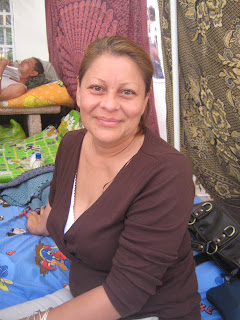

 Teacher Yanina; Five widows and Reinaldo at Guadalupe Carney settlement; Deciding what to do
I think Yanina cried not only because her future is in doubt, but so is the future of her country. As a teacher and head of household she now has no income, no job security, and no pension. Meanwhile her country is being sold out from under her by government and business interests which had just completed a 2 day international convention ( that coincided with our visit) called “Honduras is Open for Business.” Our group renamed it “Honduras is Open for Plunder,” as the terms for doing business in the country are a blatant give-away to any investor.
Yanina’s pain reflects the national crisis which is dividing the country since a military coup removed the democratically elected president, Manuel Zelaya, on June 28, 2009. Zelaya had begun to win the support of grassroots groups serving workers and the poor, so when he was put on a plane in his pajamas and flown out of the Honduras in a CIA backed maneuver, thousands of people flooded the streets in angry and sustained protest. However, the right-wing Honduran Congress was quick to support the coup and named Roberto Micheletti as interim constitutional president of the country. Thus the lines were drawn which exist til today.
Micheletti negotiated with the United States to arrange for new elections within five months to legitimize the coup, while the people, for the first time in history, organized a political resistance which became the FNRP - the National Front of Popular Resistance. In November 2009 fraudulent elections were held, President Porfirio Lobo was elected and the repression of all opposition started in earnest. For this reason Yanina and other teachers like her, have reason to fear that they might be arrested, disappeared or assassinated - the fate of hundreds of resistance activists.
This scenario formed the backdrop for my visit to Honduras from May 1st to 9th, with a delegation whose mission was to investigate the human rights abuses perpetrated by the Lobo government against anyone who identifies with the Popular Resistance, which rejects the coup, supports Zelaya’s return from exile, and advocates for the rights of campesinos to their land, teachers to their pensions, journalists for an open press, unions for better wages, protection of the environment, etc..
Our delegation was formed by the School of the Americas Watch (SOAW) and hosted by COFADEH, the Committee for Families of Detained and Disappeared of Honduras. The SOAW is concerned about the militarization of Latin America and appeals to governments to stop sending their security personnel to be trained in counter-insurgency at the School of the Americas (renamed WHINSEC) in Fort Benning, Georgia. COFADEH is a group of very courageous women who have documented over 2000 cases of abuse, including beatings, assassinations, disappearances and torture since the coup took place.
A visit to the Lower Aguan Valley in northern Honduras took us to a key area of dispute and violence. We had been invited to visit three settlements of campesinos (small farmers) who were living on and cultivating land claimed by a wealthy landowner and business tycoon named Miguel Facusse. The story behind this is long, but its essence is that agrarian reform laws passed in the 70's that gave small plots of land (but no title) to landless peasants, were reversed in the 90's, allowing Facusse and a few others to buy up almost all of these same lands. . Encouraged by community organizers and natural leaders some campesinos have joined into cooperatives, built homes with a basic infrastructure of a store and a meeting place, and taken back their lands.
The Community of Guadalupe Carney, named after an American born Jesuit priest who lived among and took the side of the poorest of Honduras, brought us to meet five women who were recently widowed.. Their husbands had been assassinated last November by Facusse’s private militia as they were working in their fields. During the attack, four other women were assaulted and raped, one with a gun to her mouth, another with a knife at her throat. Another male was shot in the face and is still in treatment, while yet another suffers from loss of memory and balance due to gunshot to his head. One of the widows had four small children and a 10 day old baby when her husband was murdered.
Reinaldo Aguilar began our meeting with a prayer before telling us the history of the community. It was formed after all its members lost their original land in Hurricane Mitch in 2000, and the Catholic church helped them access this land based on the agrarian reform laws. However, their rights were completely disregarded as local government officials sold the same land to established landowners like Facusse. The campesinos have protested to the authorities and refuse to give up the land they believe is theirs, while Facusse uses his wealth and his militia to impose his will.
Said Reinaldo, “We are learning that ‘terrorist’ is anyone who defends the poor.” Meanwhile the terror being visited upon the community is met with silence from the government. In the face of this impunity, the people say that they have with faith in God and a new-found conviction that they deserve a voice in their government.
With our own faith and convictions, the delegation set out to visit a group of 66 campesinos from another settlement, the community of Trinidad, who had been under seige for five days by Facusse’s militia. They had gone to their fields in defiance of the militia and now were trapped there. The community had been sneaking food and water to them during the nights. We drove for 20 minutes down a very rocky, narrow road, guided by three members of the community who squeezed into the front seat of our van with the driver.
We were hoping to talk to the trapped campesinos to ascertain their conditions and what we might do to help their situation. However, as we called the director of COFADEH back in Tegulcigalpa to report on our intentions, we received this advice: “DON’T GO!!! Facusse’s militia are given orders to shoot to kill, and that’s what they will do if you approach them. What’s more, they are using drugs and alcohol. Let us handle this situation from here.” With heavy hearts, we turned back to safety, acutely aware that we had that choice.


Friday, February 25, 2011
A Revolution Without Violence in Egypt -- And In Palestine?
I am almost as excited as the Egyptians who are flooding Tahrir Square with their jubilation at the news that Mubarak has fled. The TV news made me cry. I ran to the phone to call friends whom I knew would share in my elation. They won! They won without firing a shot! They won because they were many and they persisted and they knew what they were doing. Yes this was more than a spontaneous outpouring of fed-up, unemployed young people. They had been planning, using the internet and secret meetings, testing the mood in the streets.
I do not have much information about the leadership, but it seems that they are from a broad base, are not ideologues, and are respected by the crowds of ordinary people. They know what they have to lose and what they want to gain. Their goals of getting rid of a dictator and his whole oppressive regime resonate with me – and with the vast majority of the Arab Muslim world.
However, after this night of euphoria begins the hard and tricky work of creating a functional system that will protect the human rights of all Egyptians. Do the protesters have the skills and leverage to stand up to the military ? Actually, can they get the military to answer to them? The military is not neutral. It looks to where its bread is buttered; it is buttered by the U.S.. And, although Obama gave a good speech after the people’s victory, he is still the President of the Empire, and the generals/CIA do their dirty deeds behind our backs.
Meanwhile, in Palestine, when people in Ramallah first tried to demonstrate in support of the Egyptians, they were attacked by the Palestinian Authority police. They tried again on Saturday, February 5th and managed to attract 2,000 nervous participants, who didn’t dare to call for the ouster of Mahmoud Abbas, even though everyone knows he collaborates with the Israelis against his own people. The PA would prefer to see Hosni Mubarak in power, helping to control Gaza and keeping the lid on popular unrest in the Arab world.
But this status quo cannot hold any longer. If the Tunisian people have enough power to unseat their president, and the Egyptians have enough power to overturn 30 years of dictatorship, other oppressed people, including the Palestinians, know that they have the same potential. They already have a history of nonviolent resistance, and in the last 5 years more than ten villages have faced Israeli tear gas and rubber coated steel bullets at weekly nonviolent protests in the West Bank. Recently the youth in both Gaza and the West Bank have started to issue their own manifestos of fed-upness.
However, Palestinians are not united and do not speak with one voice. Over the last 60 years, Israel has managed to divide Palestinians against each other and create a huge network of collaborators. It won’t be easy to overcome this legacy, but now it seems there is a choice. Once you know you have a choice, you are almost free.
I do not have much information about the leadership, but it seems that they are from a broad base, are not ideologues, and are respected by the crowds of ordinary people. They know what they have to lose and what they want to gain. Their goals of getting rid of a dictator and his whole oppressive regime resonate with me – and with the vast majority of the Arab Muslim world.
However, after this night of euphoria begins the hard and tricky work of creating a functional system that will protect the human rights of all Egyptians. Do the protesters have the skills and leverage to stand up to the military ? Actually, can they get the military to answer to them? The military is not neutral. It looks to where its bread is buttered; it is buttered by the U.S.. And, although Obama gave a good speech after the people’s victory, he is still the President of the Empire, and the generals/CIA do their dirty deeds behind our backs.
Meanwhile, in Palestine, when people in Ramallah first tried to demonstrate in support of the Egyptians, they were attacked by the Palestinian Authority police. They tried again on Saturday, February 5th and managed to attract 2,000 nervous participants, who didn’t dare to call for the ouster of Mahmoud Abbas, even though everyone knows he collaborates with the Israelis against his own people. The PA would prefer to see Hosni Mubarak in power, helping to control Gaza and keeping the lid on popular unrest in the Arab world.
But this status quo cannot hold any longer. If the Tunisian people have enough power to unseat their president, and the Egyptians have enough power to overturn 30 years of dictatorship, other oppressed people, including the Palestinians, know that they have the same potential. They already have a history of nonviolent resistance, and in the last 5 years more than ten villages have faced Israeli tear gas and rubber coated steel bullets at weekly nonviolent protests in the West Bank. Recently the youth in both Gaza and the West Bank have started to issue their own manifestos of fed-upness.
However, Palestinians are not united and do not speak with one voice. Over the last 60 years, Israel has managed to divide Palestinians against each other and create a huge network of collaborators. It won’t be easy to overcome this legacy, but now it seems there is a choice. Once you know you have a choice, you are almost free.
Monday, January 17, 2011
There Is a Man Under That Hood
THERE'S A MAN UNDER THAT HOOD
I am hungry. It is the third day of a 12 day liquids-only fast. I am in the company of about 40 other fasters whose spirit and commitment keep me going. Our purpose also keeps me going We are trying to bring justice to the remaininng 173 Muslim detainees at Guantanamo Bay Prison who are being held indefinitely by our government, some already cleared for release others not yet charged with any crime. And they're not the only ones. We know that there are at least 600 men in detention --without access to lawyers -- at Bagram Air Force base in Afghanistan and some others at secret sites around the world.
In our criminal-justice system people in prison are supposed to have done something wrong, told what they did, and given a trial to determine if they are guilty. Not that that system runs perfectly. Not that it isn't sometimes arbitrary and unjust, but with a good lawyer, you can hope for justice. The men at Guantanamo Military tribunals have cleared 90 of them for release, but they are still there. The others, although given the right of habeas corpus by our Supreme Court back in 2008, are still there, still without being charged with anything and still without access to a trial.
So we in Witness Against Torture are bearing witness to their suffering by fasting, vigiling, processing slowly through the streets of Washington in orange jumpsuits and black hoods, lobbying and risking arrest. Here's what that feels like:
Today (January 13) the temperature was around 35 degrees in the sun, but about 20 degrees when the wind blew. I had on my down jacket and long underwear under the jumpsuit but my fingers were cold until Matt handed out hand-warmers. Our group of about 40 vigiled outside a Federal District court where the ACLU was getting a preliminary hearing on the case of Ali v Rumsfeld. (Guess who is the criminal in this case.) Having been barred from entering the courthouse (we think illegally), we stood still or walked slowly in a circle. Standing still made my lower back ache, and holding my hands behind my back made my shoulders ache. So there I am, cold, hungry and aching and wondering how long this would last before our leadership would announce that it was time to stop that particular action. Under my black hood, hands behind me, I couldn't be looking at my watch, and being part of a solemn, silent and purposeful vigil, I couldn't just sit down or walk off.
While I am standing, I start to think trivial thoughts- like needing to remember to cut the nail I broke this morning. When I catch my mind wandering aimlessly like that, I attempt to focus myself. I think about the people I usually pray for every day. That feels worthwhile, but doesn't last long before I have strayed back into trivia. Then I think about the men at Guantanamo and the horrible journeys they have been on from capture to torture to indefinite imprisonment. I have seen documentaries showing their ordeals, which remind me of the pictures that came out of Abu Greib prison in Iraq a few years ago.
I am cold, but they were colder, with no warm clothing, no blankets and sometimes tortured by having cold water poured over them. My shoulders ache, but they were tied in stress positions, or made to stand against a wall with their arms shackled over their heads their feet barely touching the floor, for hours on end. I am hungry, but they were hungry and then fed such filthy food that they went on a hunger strike. If they persisted, they were force fed by a tube through the nose, sometimes overfed so that they were bloated, and then the tube would be yanked out causing pain. I am under a hood through which I can see dimly, but they were put under purposely foul-smelling, very thick hoods that made them feel like they were suffocating. I wish this standing in the cold would be over-- knowing it will be, but these men never knew when their torture session would be over and now don't know when or if they will ever be released. Our fasting is an act of solidarity with their suffering.
Of these 173 men, 90 have been cleared for release by their captors. But they are not released. Fifty-eight of them are from Yemen, and President Obama has signed an order that no more men be released to Yemen...because the Christmas bomber was trained there. So far no other country has offered to take these men. The other 31 cleared men are also waiting for a country to take them, because the U.S. has passed a law against receiving them here. Forty-eight detainees have been designated as too dangerous to release - ever. Does that mean that they have been tried and found guilty of horrific crimes? No, it means they are being held without charge or trial - most likely because we have tortured them so badly, that we dare not set them free. That leaves 33 detainees who have had or will have a military commissions trial, a highly discredited substitute for justice.
A poet from New York City's "Peace Poets" named Luke recited a very moving poem he wrote-- and I hope to post as soon as I get a copy -- in front of the Department of Justice where we were temporarily blocking the entrance. It's title and repeated refrain is, "There is a man under that hood," and that is what we want our government to recognize. Personally, I fear for my country when it carries out policies like indefinite detention and will not prosecute those who have been proven to have authorized torture. We must see that there are men under those hoods, men who should be treated humanely and justly.
We fast and protest for justice because our country is in a moral, and some would say a constitutional crisis, where the loss of civil and human rights for one group is a slippery slope for us all.
I am hungry. It is the third day of a 12 day liquids-only fast. I am in the company of about 40 other fasters whose spirit and commitment keep me going. Our purpose also keeps me going We are trying to bring justice to the remaininng 173 Muslim detainees at Guantanamo Bay Prison who are being held indefinitely by our government, some already cleared for release others not yet charged with any crime. And they're not the only ones. We know that there are at least 600 men in detention --without access to lawyers -- at Bagram Air Force base in Afghanistan and some others at secret sites around the world.
In our criminal-justice system people in prison are supposed to have done something wrong, told what they did, and given a trial to determine if they are guilty. Not that that system runs perfectly. Not that it isn't sometimes arbitrary and unjust, but with a good lawyer, you can hope for justice. The men at Guantanamo Military tribunals have cleared 90 of them for release, but they are still there. The others, although given the right of habeas corpus by our Supreme Court back in 2008, are still there, still without being charged with anything and still without access to a trial.
So we in Witness Against Torture are bearing witness to their suffering by fasting, vigiling, processing slowly through the streets of Washington in orange jumpsuits and black hoods, lobbying and risking arrest. Here's what that feels like:
Today (January 13) the temperature was around 35 degrees in the sun, but about 20 degrees when the wind blew. I had on my down jacket and long underwear under the jumpsuit but my fingers were cold until Matt handed out hand-warmers. Our group of about 40 vigiled outside a Federal District court where the ACLU was getting a preliminary hearing on the case of Ali v Rumsfeld. (Guess who is the criminal in this case.) Having been barred from entering the courthouse (we think illegally), we stood still or walked slowly in a circle. Standing still made my lower back ache, and holding my hands behind my back made my shoulders ache. So there I am, cold, hungry and aching and wondering how long this would last before our leadership would announce that it was time to stop that particular action. Under my black hood, hands behind me, I couldn't be looking at my watch, and being part of a solemn, silent and purposeful vigil, I couldn't just sit down or walk off.
While I am standing, I start to think trivial thoughts- like needing to remember to cut the nail I broke this morning. When I catch my mind wandering aimlessly like that, I attempt to focus myself. I think about the people I usually pray for every day. That feels worthwhile, but doesn't last long before I have strayed back into trivia. Then I think about the men at Guantanamo and the horrible journeys they have been on from capture to torture to indefinite imprisonment. I have seen documentaries showing their ordeals, which remind me of the pictures that came out of Abu Greib prison in Iraq a few years ago.
I am cold, but they were colder, with no warm clothing, no blankets and sometimes tortured by having cold water poured over them. My shoulders ache, but they were tied in stress positions, or made to stand against a wall with their arms shackled over their heads their feet barely touching the floor, for hours on end. I am hungry, but they were hungry and then fed such filthy food that they went on a hunger strike. If they persisted, they were force fed by a tube through the nose, sometimes overfed so that they were bloated, and then the tube would be yanked out causing pain. I am under a hood through which I can see dimly, but they were put under purposely foul-smelling, very thick hoods that made them feel like they were suffocating. I wish this standing in the cold would be over-- knowing it will be, but these men never knew when their torture session would be over and now don't know when or if they will ever be released. Our fasting is an act of solidarity with their suffering.
Of these 173 men, 90 have been cleared for release by their captors. But they are not released. Fifty-eight of them are from Yemen, and President Obama has signed an order that no more men be released to Yemen...because the Christmas bomber was trained there. So far no other country has offered to take these men. The other 31 cleared men are also waiting for a country to take them, because the U.S. has passed a law against receiving them here. Forty-eight detainees have been designated as too dangerous to release - ever. Does that mean that they have been tried and found guilty of horrific crimes? No, it means they are being held without charge or trial - most likely because we have tortured them so badly, that we dare not set them free. That leaves 33 detainees who have had or will have a military commissions trial, a highly discredited substitute for justice.
A poet from New York City's "Peace Poets" named Luke recited a very moving poem he wrote-- and I hope to post as soon as I get a copy -- in front of the Department of Justice where we were temporarily blocking the entrance. It's title and repeated refrain is, "There is a man under that hood," and that is what we want our government to recognize. Personally, I fear for my country when it carries out policies like indefinite detention and will not prosecute those who have been proven to have authorized torture. We must see that there are men under those hoods, men who should be treated humanely and justly.
We fast and protest for justice because our country is in a moral, and some would say a constitutional crisis, where the loss of civil and human rights for one group is a slippery slope for us all.
Subscribe to:
Posts (Atom)